
It took you hours to shovel and brush the snow off your car. You're frustrated at the plows for blocking your driveway and at poor driving conditions. You've forgotten that graying piles of snow are mounds of tiny crystals.
I forget how frustrating snow can be when I stop to remember how beautiful it is.

Up in the cold clouds ice crystals form on dust particles as water vapor condenses. Partially melted crystals cling together to form snowflakes.
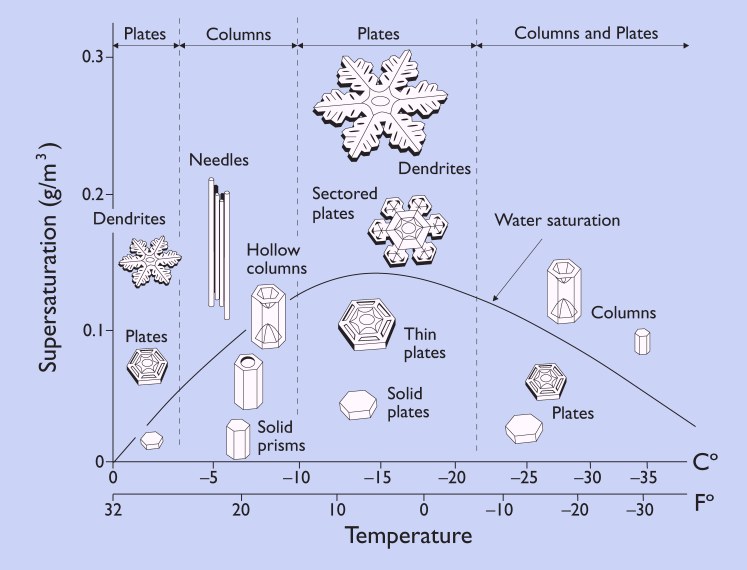 |
| Figure Credit: Kenneth G. Libbrecht; Professor of Physics at Caltech |
Shape depends on the variations in temperature and humidly on a crystal's path to the ground. Every path, and therefore every snowflake is unique.
What kinds of snowflakes are landing in your backyard? Catch them to find out:

You'll need falling snow, (chilled) black paper, and a magnifying glass (or not).

I put the black paper in the freezer for about a half-hour before
heading outside, you don't want your snowflakes to land and melt. You might want to anchor the paper so it doesn't blow
away. I still don't know where one of my sheets of paper landed.

A cluster of snowflakes on a cold piece of paper. Maybe you don't even need paper:

A snowflake on the chilled sleeve of my sweatshirt.

A snowflake lingering on my cold car.

You'll still need falling snow, some liquid plastic spray (like Krylon Crystal Clear), and microscope slides (or piece of clear plastic/glass; be creative).
Before catching snow, put the spray and slides in the freezer for about an hour, you don't want your materials melting the snowflakes. Spray the slides and let the snow flakes fall! The liquid plastic will form a shell preserving the snowflake's detail, resulting in a replica of your snowflakes. .

And if you have a USB-microscope you can photograph your snowflake on a slide.

Happy snowflake catching!


