Showing posts with label observation. Show all posts

Wednesday, August 13, 2014

What Would Happen if You Turned Your Child's Frustrating Distraction Into an Accidental Scientific Investigation?

I hear my neighbors out the window, biking home. The little girl is dillydalling. Her dad, already home, is audibly annnoyed. And then she screams:

I found a worm!

Dad sighs; his demeanor shifts: A WORM! Bring it here! Show it to me!

I hear her bring her bike, and worm, s.l.o.w.l.y. to her dad. Her patient dad.
I can still hear them through the window, discussing this worm. It's a boy and a girl, he tells her. I found himher near the grass, she reports. He asks her what she thinks himher likes to do?

He doesn't need to lecture his daughter, of training-wheels age, about hermaphroditic reproductive strategies. Or that her discovery is probably a member of the Amynthas genus, and that there are native and invasive earthworms. Or how himher burrows in the soil eating dead and decaying things; such a small thing making mechanical and chemical changes to the soil. Or even that Charles Darwin wrote: "It may be doubted whether there are many other animals which have played so important a part in the history of the world, as have these lowly organized creatures."

He just connected with her and fostered her connection with nature. Over a worm.

Saturday, January 14, 2012

Catch a Falling Snowflake

And put it under observation!

It took you hours to shovel and brush the snow off your car. You're frustrated at the plows for blocking your driveway and at poor driving conditions. You've forgotten that graying piles of snow are mounds of tiny crystals.

I forget how frustrating snow can be when I stop to remember how beautiful it is.


No two snowflakes are the same! But all flake crystals have six sides due to the shape and bonding of water molecules. 

Up in the cold clouds ice crystals form on dust particles as water vapor condenses. Partially melted crystals cling together to form snowflakes.  


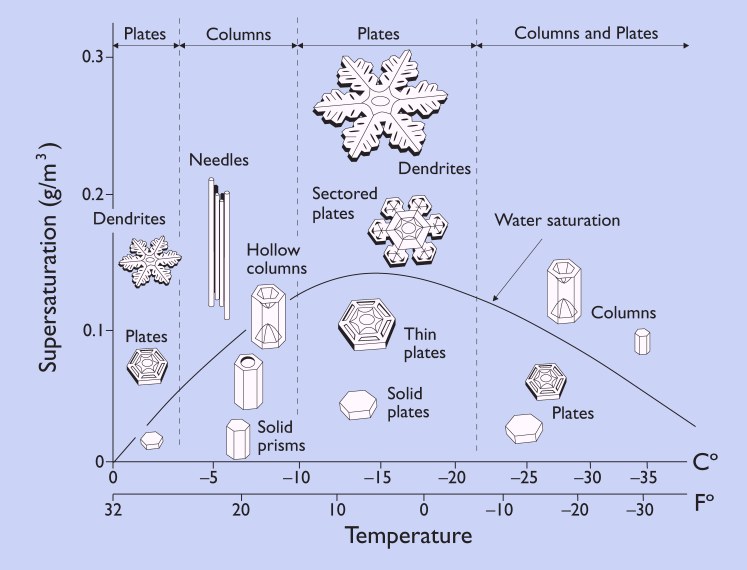
Figure Credit: Kenneth G. Libbrecht; Professor of Physics at Caltech
There are types of crystal shapes: plates, dendrites, needles, columns, columns with plates, and the beautiful dendrite plate stars.

Shape depends on the variations in temperature and humidly on a crystal's path to the ground. Every path, and therefore every snowflake is unique.


What kinds of snowflakes are landing in your backyard? Catch them to find out:
 You'll need falling snow, (chilled) black paper, and a magnifying glass (or not).

 
I put the black paper in the freezer for about a half-hour before heading outside, you don't want your snowflakes to land and melt. You might want to anchor the paper so it doesn't blow away. I still don't know where one of my sheets of paper landed.

 A cluster of snowflakes on a cold piece of paper. Maybe you don't even need paper:
 A snowflake on the chilled sleeve of my sweatshirt.
A snowflake lingering on my cold car.
  Perhaps you're up for more of a challenge?!

You'll still need falling snow, some liquid plastic spray (like Krylon Crystal Clear), and microscope slides (or piece of clear plastic/glass; be creative). 
Before catching snow, put the spray and slides in the freezer for about an hour, you don't want your materials melting the snowflakes. Spray the slides and let the snow flakes fall! The liquid plastic will form a shell preserving the snowflake's detail, resulting in a replica of your snowflakes.  .
 And if you have a USB-microscope you can photograph your snowflake on a slide.

Happy snowflake catching!