Showing posts with label nature. Show all posts

Wednesday, August 13, 2014

What Would Happen if You Turned Your Child's Frustrating Distraction Into an Accidental Scientific Investigation?

I hear my neighbors out the window, biking home. The little girl is dillydalling. Her dad, already home, is audibly annnoyed. And then she screams:

I found a worm!

Dad sighs; his demeanor shifts: A WORM! Bring it here! Show it to me!

I hear her bring her bike, and worm, s.l.o.w.l.y. to her dad. Her patient dad.
I can still hear them through the window, discussing this worm. It's a boy and a girl, he tells her. I found himher near the grass, she reports. He asks her what she thinks himher likes to do?

He doesn't need to lecture his daughter, of training-wheels age, about hermaphroditic reproductive strategies. Or that her discovery is probably a member of the Amynthas genus, and that there are native and invasive earthworms. Or how himher burrows in the soil eating dead and decaying things; such a small thing making mechanical and chemical changes to the soil. Or even that Charles Darwin wrote: "It may be doubted whether there are many other animals which have played so important a part in the history of the world, as have these lowly organized creatures."

He just connected with her and fostered her connection with nature. Over a worm.

Saturday, January 14, 2012

Catch a Falling Snowflake

And put it under observation!

It took you hours to shovel and brush the snow off your car. You're frustrated at the plows for blocking your driveway and at poor driving conditions. You've forgotten that graying piles of snow are mounds of tiny crystals.

I forget how frustrating snow can be when I stop to remember how beautiful it is.


No two snowflakes are the same! But all flake crystals have six sides due to the shape and bonding of water molecules. 

Up in the cold clouds ice crystals form on dust particles as water vapor condenses. Partially melted crystals cling together to form snowflakes.  


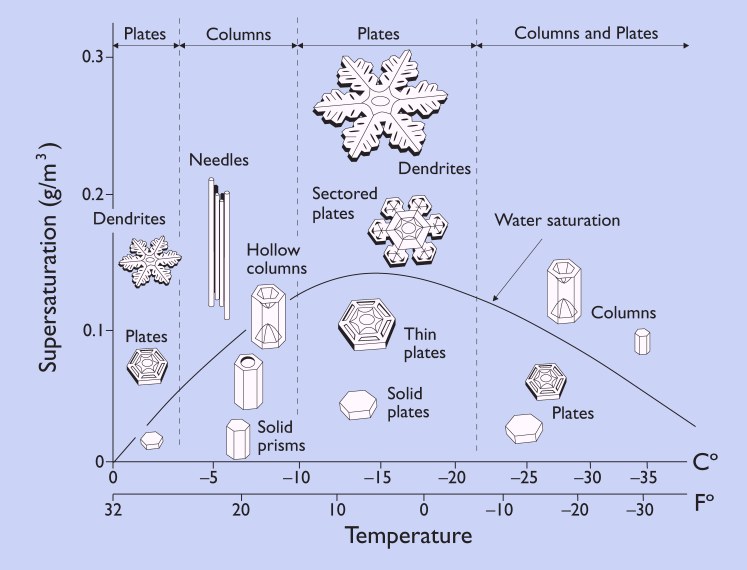
Figure Credit: Kenneth G. Libbrecht; Professor of Physics at Caltech
There are types of crystal shapes: plates, dendrites, needles, columns, columns with plates, and the beautiful dendrite plate stars.

Shape depends on the variations in temperature and humidly on a crystal's path to the ground. Every path, and therefore every snowflake is unique.


What kinds of snowflakes are landing in your backyard? Catch them to find out:
 You'll need falling snow, (chilled) black paper, and a magnifying glass (or not).

 
I put the black paper in the freezer for about a half-hour before heading outside, you don't want your snowflakes to land and melt. You might want to anchor the paper so it doesn't blow away. I still don't know where one of my sheets of paper landed.

 A cluster of snowflakes on a cold piece of paper. Maybe you don't even need paper:
 A snowflake on the chilled sleeve of my sweatshirt.
A snowflake lingering on my cold car.
  Perhaps you're up for more of a challenge?!

You'll still need falling snow, some liquid plastic spray (like Krylon Crystal Clear), and microscope slides (or piece of clear plastic/glass; be creative). 
Before catching snow, put the spray and slides in the freezer for about an hour, you don't want your materials melting the snowflakes. Spray the slides and let the snow flakes fall! The liquid plastic will form a shell preserving the snowflake's detail, resulting in a replica of your snowflakes.  .
 And if you have a USB-microscope you can photograph your snowflake on a slide.

Happy snowflake catching! 


Thursday, December 1, 2011

Sandhill Cranes Soar High Over Chicago

What do you mean it's December? It seems like just yesterday I was buying pencils for the new school year, and today I looked up into the sky to see the greater sandhill cranes (Grus canadensis) migrating south from their northern breeding ranges to their wintering area in Florida.

As my friend Leah and I were walking into Foreman High School, on Chicago's northwest side, we heard the sounds of trumpets overhead. We saw about 150 sandhill cranes soaring higher than I've ever seen birds fly. Their height drew attention to their large size (4.5-5 feet tall and 10-14 pounds). Majestic.

My friend Jill reported that the cranes flew over Aurora, IL earlier in the week. As they fly to their stopover at Indiana's Jasper-Pulaski Fish & Wildlife Area through mid-December, you might hear trumpets high above you!

Photo used with permission; International Crane Foundation

Photo used with permission; International Crane Foundation

Photo used with permission; International Crane Foundation

Aldo Leopold's classic A Sand County Almanac which included the essay "Marshland Elegy" was published in 1948, decades ahead of its time. His sobering essay asks us if humanity's progress is progressive if it's short-sighted, wasteful, and results in the displacement of other species, like the cranes. In the 1930s, Aldo didn't hear many cranes soaring over Baraboo, WI despite the abundant wetlands. "For (the cranes), the song of the power shovel came near being an elegy. The high priests of progress knew nothing of cranes, and cared less. Some day, perhaps in the very process of our benefactions, perhaps in the fullness of geologic time, the last crane will trumpet his farewell and spiral skyward from the great marsh." Due to conservation and restoration efforts, the greater sandhill crane's numbers have made a remarkable recovery, but the biggest threats to the sandhill cranes are the loss and degradation of riverine and wetland ecosystems. Below is the ~13 minute trailer for the documentary Green Fire: Aldo Leopold and a Land Ethic for our Time that is, in a word: indispensable.


“We abuse land because we regard it as a commodity belonging to us. When we see land as a community to which we belong, we may begin to use it with love and respect." ~Aldo Leopold, A Sand County Almanac

Wednesday, November 23, 2011

Happy Thanksgiving Pine Cone Turkeys!

It's Thanksgiving!

In the midst of cooking turkeys and tofu, smashing potatoes, opening cans of cranberry sauce with the ridges on the jellied-cylinder, drizzling honey on cornbread, baking pumpkins into pie, and opening the wine early...you might be thinking "with all the thanks for all this food grown from the Earth, how could I possibly connect to nature any more?!?"

How could you possibly not find more ways to connect to nature!?! Tis the season when plants sprinkle the landscape with their seeds, and evergreen trees (conifers) drop cones (their reproductive organs). I think pine cones are one of the perfect natural treasures to collect while out and about.

With a pine cone, pipe-cleaners, small objects for eyes, some glue, your imagination, and the inspiration pictured below...you (and the kids in your life) can connect a little more to nature with a teeny-tiny turkey!

Turkeys pictured were made today by some of the creative and inspiring teen Ambassadors of Urban Wilderness that I work with in an After School Matters' science program in Chicago.

Tuesday, November 22, 2011

Learn to love science. Or at the very least, learn to appreciate it.

So many of us, even I, struggle with science (and math). This can leave us disliking, even hating, science. Science is hard. But luckily for us: we all think like scientists to manage life's challenges, we're all inherently curious, & this sets all of us up to master scientific concepts. If you, or someone you know is struggling to master science, you might feel like your inherent curiosity can't help you. Maybe you feel like you couldn't tap into this resource if you knew where to find it.

Maybe you're a parent who'd like to foster positive interactions between your child & the natural world but you feel overwhelmed by all the other nurturing you do. You may even feel you're not equipped to effectively connect your children to nature in our built-up world.

This is where I come in.

I am enthusiastic about connecting students of all types to science & nature; to foster their intrinsic curiosity; to inspire them to overcome obstacles in their learning process; and to creatively link concepts to their collected knowledge. I'm dedicated to strengthening scientific literacy and fostering positive connections with science & nature. I developed “Learn To Love Science; Biology Tutoring & Science Camps" for biology students of all ages in need of tutoring as well as science camps (and birthday parties) for junior scientists from age four to eleven.

I truly believe that every student is a scientist & in strengthening scientific literacy & fostering positive connections with nature! Welcome to my new blog, come back to read about teaching science; life in & after graduate school; volunteering in a play zoo; science camp updates; and inspiring ways to connect to the natural world for you & your family!